


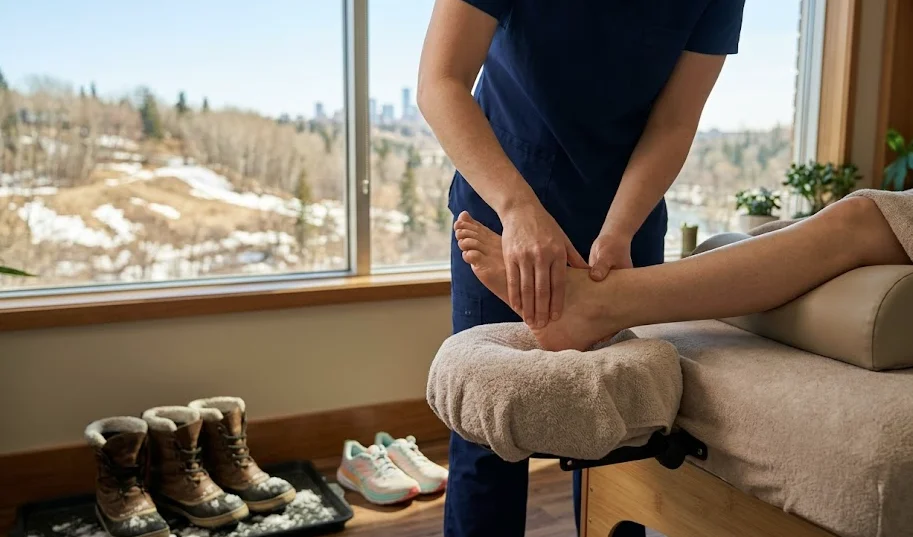
The snow is finally retreating from the Edmonton River Valley, the days are getting longer, and the unmistakable feeling of spring is in the air. For many Edmontonians, this means one highly anticipated ritual: finally packing away those heavy, clunky winter boots.
But while your mind is ready for lighter footwear, spring walks, and summer running, your feet might be in for a rude awakening. The sudden transition from rigid, heavy winter boots to lightweight sneakers, flats, or running shoes is a primary trigger for early spring foot pain. At The Touch Massage in Edmonton, we see a massive influx of clients during this season complaining of aching arches, tight calves, and the dreaded, sharp heel pain known as plantar fasciitis.
If your feet are screaming after your first few spring outings, you are not alone. In this comprehensive guide, we will explore why the seasonal footwear swap causes so much grief, what plantar fasciitis actually is, and how targeted massage therapy can provide both deep clinical relief and profound relaxation.
The Winter Boot Hangover: Why Your Feet Are Hurting
To understand why your feet hurt in April, we have to look at what they’ve been doing since November. Edmonton winters require serious footwear. We rely on thick soles to keep the cold out and rigid treads to keep us from slipping on icy sidewalks. However, these necessary winter features come at a cost to the biomechanics of your feet.
1. The “Cast” Effect of Winter Boots
Heavy winter boots often act like casts for your feet and ankles. Because the boot does the work of stabilizing your ankle against the snow and ice, the small intrinsic muscles of your feet and lower legs don’t have to work as hard. Over a long Edmonton winter, these muscles can become deconditioned, stiff, and weak.
2. Altered Gait and Heavy Steps
Think about how you walk in the snow. You likely adopt a heavier, flatter, more cautious gait to avoid slipping. This “winter shuffle” alters your natural biomechanics. It often leads to shortened, tight calf muscles (the gastrocnemius and soleus) because your ankle isn’t moving through its full, natural range of motion.
3. Poor Arch Support
While winter boots are great for warmth, many lack proper orthopedic arch support. Spending six months walking on flat, hard insoles can cause the arches of your feet to flatten and the connective tissue to become strained.
The Shock of the Spring Switch
When the pavement finally clears and you slip into your favorite pair of lightweight sneakers, flats, or running shoes, your feet experience a sudden shock.
Suddenly, those small, deconditioned foot muscles are forced to wake up and stabilize your every step. The tight calf muscles are abruptly stretched as you return to a normal, heel-to-toe walking stride. And without the rigid support of the boot, the connective tissues in your foot are subjected to increased load and tension.
This sudden increase in demand, combined with tight lower leg muscles, is the perfect recipe for the most common springtime foot complaint: Plantar Fasciitis.
What is Plantar Fasciitis?
Plantar fasciitis (pronounced PLAN-tar fash-ee-EYE-tis) is one of the most common causes of heel pain. It involves the inflammation, irritation, or micro-tearing of a thick band of tissue called the plantar fascia.
The plantar fascia runs across the bottom of your foot, connecting your heel bone (calcaneus) to your toes. It acts like a shock-absorbing bowstring, supporting the arch of your foot. When tension and stress on this bowstring become too great, small tears can occur in the fascia.
Recognizing the Symptoms
How do you know if you are suffering from plantar fasciitis or just general foot fatigue? Look for these hallmark signs:
-
The “First Step” Pain: This is the classic symptom. You experience a sharp, stabbing pain in the heel or arch of your foot during your very first steps out of bed in the morning.
-
Pain After Resting: Similar to the morning pain, you might feel a sharp ache when standing up after sitting at your desk or driving for a long period.
-
Pain That Decreases with Movement: The pain often subsides after you walk around for a few minutes and the tissue warms up, only to return later in the day after prolonged standing or exercise.
-
Tenderness at the Heel: The bottom of your heel may feel bruised or tender to the touch.
How Massage Therapy Treats Plantar Fasciitis and Foot Pain
When you are in pain, you might think the only solution is rest, pain killers, or expensive custom orthotics. However, at The Touch Massage, we know that addressing the soft tissue is a crucial step in finding lasting relief.
Massage therapy is incredibly effective for treating foot pain because it doesn’t just target the site of the pain (the foot); it addresses the root mechanical causes further up the leg. Here is how our expert massage therapists tackle spring foot pain:
1. Releasing the Calves (The Root of the Problem)
The plantar fascia and the Achilles tendon are intimately connected. The calf muscles (gastrocnemius and soleus) merge into the Achilles tendon, which attaches to the heel bone. The plantar fascia also attaches to the bottom of this exact same bone.
If your calf muscles are tight from winter boots, they pull upward on the heel bone. This creates immense, continuous tension on the plantar fascia on the bottom of the foot. Our therapists focus heavily on deep tissue massage and myofascial release of the calves to slacken this tension. Loosening the calves is often the fastest way to relieve pressure on the arch of the foot.
2. Breaking Down Fascial Adhesions
When the plantar fascia is injured, the body lays down scar tissue to heal it. If this scar tissue isn’t mobilized, it can become rigid and cause further pain. Massage techniques, including cross-fiber friction, help break down these adhesions, encouraging the tissue to heal in a more flexible, aligned manner.
3. Improving Circulation and Healing
The bottom of the foot, particularly the fascia, is notoriously slow to heal because it naturally has poor blood supply. Massage therapy manually stimulates blood flow to the area. This influx of fresh, oxygenated blood brings essential nutrients to the damaged tissue while flushing out cellular waste and inflammatory byproducts.
4. Joint Mobilization
Stiff ankles and immobile foot joints force the plantar fascia to work overtime. By gently mobilizing the joints of the ankle and the mid-foot, a massage therapist can restore proper biomechanics, allowing your foot to distribute your body weight evenly and efficiently as you walk.
The Intersection of Healing: Massage and Relaxation
When discussing clinical issues like plantar fasciitis, it is easy to get caught up in anatomy and biomechanics. However, we cannot overlook the profound importance of relaxation in the healing process.
At The Touch Massage, we firmly believe that clinical effectiveness and deep relaxation are not mutually exclusive. In fact, relaxation is a biological requirement for optimal healing.
Down-Regulating the Nervous System
Living with chronic foot pain is stressful. Every time you take a painful step, your sympathetic nervous system (your “fight or flight” response) flares up. This chronic stress leads to global muscle tension, making your tight calves even tighter.
A well-executed foot and leg massage stimulates the parasympathetic nervous system (your “rest and digest” state). By inducing deep relaxation, your overall muscle tone decreases, your breathing deepens, and your body can redirect its energy toward tissue repair rather than stress management.
The Reflexology Connection
Even if you are coming into the clinic specifically for Foot Pain and Plantar Fasciitis with Massage, the benefits of having your feet worked on extend far beyond your lower legs. Treating the feet provides a profound, systemic level of full-body relaxation that few other treatments can match.
To understand why, we have to look at the unique anatomy of the foot. Each of your feet contains roughly 7,000 to 8,000 nerve endings. In the practice of reflexology, the foot is viewed as a microcosmic map of the entire body, with specific zones corresponding to different organs, glands, and muscle groups.
Even during a clinical orthopedic massage focused on the plantar fascia, manipulating this highly sensitive, nerve-dense tissue triggers a cascade of positive, full-body responses:
-
The Parasympathetic Shift: Constant pain—like the sharp stabbing of plantar fasciitis—keeps your body locked in a low-grade “fight-or-flight” state of stress. Massaging the nerve endings in the feet acts like a reset button, activating your parasympathetic nervous system (your “rest-and-digest” mode). This lowers your heart rate, decreases cortisol levels, and encourages your entire body to physically let go of tension. If you have been exploring acupuncture treatments, foot work is a highly complementary addition to your routine.
-
The “Grounding” Effect: After months of being bundled up in heavy winter boots and navigating slippery, icy Edmonton sidewalks, we often become physically disconnected from our foundation. Focused foot massage restores proprioception (your brain’s awareness of your body in space), leaving clients feeling deeply rooted, balanced, and physically grounded. It offers a unique energetic reset, similar to the rejuvenating flow of a Traditional Thai Massage.
-
Clearing Winter Brain Fog: The transition out of a long Edmonton winter isn’t just physically taxing; it takes a mental toll. The deep, rhythmic pressure applied to the arches and heels stimulates endorphin release. Many clients report that a focused foot treatment clears away mental fatigue and leaves them feeling mentally sharp.
-
Connecting the Biomechanical Chain: Everything in the body is connected. Often, foot pain doesn’t happen in a vacuum. If you suffer from tight hips from sitting at a desk all day, that pelvic imbalance can alter your gait and put extra strain on your feet. Targeting these compensations with deep tissue massage can have a positive ripple effect all the way down your kinetic chain.
Ultimately, addressing your foot pain doesn’t just repair a mechanical issue. It melts away the lingering physical and mental stress of the long winter, allowing you to successfully prep for activity with tailored massage therapy and step into the new season feeling truly revitalized from the ground up.
Home Care: Preserving Your Progress Between Massages
While a therapeutic massage at our clinic will kickstart your healing, managing foot pain requires a little bit of homework. Here are our top tips for keeping plantar fasciitis at bay as you transition into spring:
-
The Gradual Switch: Don’t go straight from winter boots to flat, unsupportive sandals. Transition gradually. Wear supportive running shoes for a few weeks to let your feet adjust to a normal gait before bringing out the summer flats.
-
The Frozen Water Bottle Roll: Keep a plastic water bottle in your freezer. At the end of the day, roll the arch of your bare foot over the frozen bottle for 10-15 minutes. This provides a gentle massage while icing the inflamed fascia simultaneously.
-
Morning Calf Stretches: Before you take your first painful step out of bed, loop a towel around the ball of your foot and gently pull your toes toward your shin. Keep your knee straight. Hold for 30 seconds to stretch the calf and fascia before bearing weight.
-
Supportive Footwear Indoors: If you have hardwood or tile floors in your home, avoid going barefoot while your feet are healing. Wear a pair of supportive, indoor-only athletic shoes or recovery slides to cushion your steps.
Ready to Step Comfortably into Spring?
Do not let foot pain keep you from enjoying the Edmonton River Valley or your neighborhood spring walks. Whether you are dealing with an acute flare-up of plantar fasciitis, lingering tension from winter boots, or you simply need a deeply restorative session of massage and relaxation, our team is here to help.
At The Touch Massage, our experienced therapists know exactly how to assess your lower body biomechanics, release the stubborn tension in your calves, and soothe the inflamed tissues of your feet. We combine clinical precision with a soothing, relaxing environment so you can walk out of our clinic feeling lighter, looser, and pain-free.
Your feet carry you through everything. It’s time to return the favor. Book your appointment at The Touch Massage today, and let us help you step confidently into the new season.
