


There is a specific kind of tired that only a shift worker understands.
It isn’t just the sleepiness of a late night. It is a bone-deep heaviness. It’s the throbbing in your heels after clocking 20,000 steps on hard hospital linoleum. It’s the dull ache in your lower lumbar spine from bending over patient beds, adjusting IVs, or maneuvering wheelchairs. It’s the mental “fog” that settles in when your cortisol levels are spiking, yet your body is screaming for rest.
If you work in healthcare—whether you are an RN, LPN, HCA, Porter, or Physician—you know that the “12-hour shift” is rarely just 12 hours. It’s the commute, the report, the charting, and the decompression time afterwards.
At The Touch Massage, we specialize in massage for nurses and shift workers. Located here in the Tamarack neighborhood of Southeast Edmonton, we are just a short drive down 23rd Avenue from the Grey Nuns Community Hospital. Because of our proximity, we have become a quiet refuge for many healthcare professionals who need to physically and mentally reset after a grueling rotation.
We know that for you, self-care isn’t a luxury—it is maintenance. You are the engine that keeps our healthcare system running. But even the most reliable engines need a tune-up to prevent a breakdown.
In this comprehensive guide, we are going to explore exactly what a 12-hour shift does to your anatomy and how targeted therapies—specifically Thai Massage and Deep Tissue work—can help you survive the grind and enjoy your days off.
Part 1: The Physiology of the “Shift Hangover”
Why do you feel so wrecked after a set of three? It’s not just in your head; it is physiological.
When you work against your natural circadian rhythm (especially on nights), your body stays in a state of “sympathetic arousal.” This is your Fight or Flight mode. To keep you alert at 3:00 AM, your body pumps out cortisol and adrenaline.
While this keeps you functioning during the code blue or the medication round, it wreaks havoc when you try to stop.
-
Muscular Armor: High cortisol keeps muscles tense, ready for action. You might not notice you are shrugging your shoulders or clenching your jaw until you get in the car to drive home.
-
Inflammation: Chronic stress creates systemic inflammation. That old knee injury hurts more after a night shift than a day shift because your body’s inflammatory response is heightened.
-
The “Wired and Tired” Cycle: You get home, exhausted, but your brain is still buzzing. You can’t sleep deeply, which prevents muscle tissue repair, leading to cumulative fatigue.
Massage therapy is one of the few interventions that physically forces the body to switch from the Sympathetic (Fight/Flight) to the Parasympathetic (Rest/Digest) nervous system. It lowers heart rate, drops cortisol levels, and signals to your brain that “the emergency is over.”
Part 2: The Battle Against “Hospital Foot” (Plantar Fasciitis)
If you are working a 12-hour shift, you are likely standing or walking for 10 to 11 of those hours. Even with the best compression socks and high-end nursing clogs, the impact of concrete subfloors takes a toll.
The most common complaint we see from our Grey Nuns clients is plantar fasciitis. This is that sharp, stabbing pain in your heel, usually worst with those first few steps in the morning or after you’ve been sitting for a quick break.
The Hidden Cause: It’s Not Just Your Foot
Many people try to treat plantar fasciitis by rolling a ball under their foot. While this feels good, it often misses the root cause: Your Calves.
The plantar fascia is a thick band of tissue connecting your heel to your toes. However, anatomically, it is continuous with the Achilles tendon and the calf muscles (Gastrocnemius and Soleus). When your calves are tight from 12 hours of standing, they pull upward on the heel bone. This creates constant tension on the arch of your foot, like a bowstring being pulled too tight.
How We Fix It at Touch Massage
-
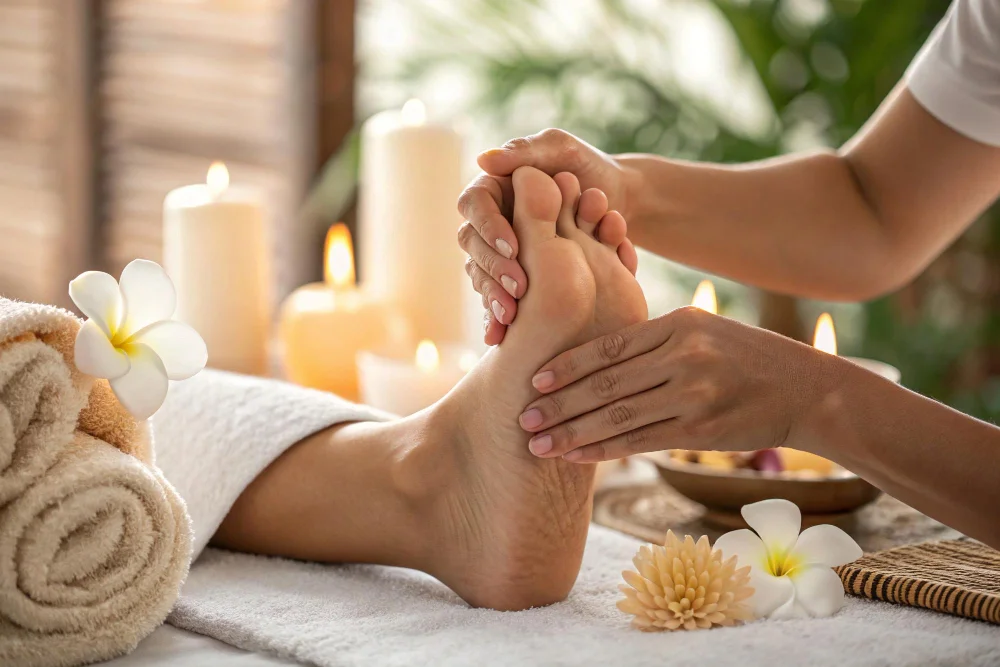
Deep Tissue & Foot Reflexology: We don’t just rub the foot; we work deeply on the calf muscles (the “gastroc”). By releasing the trigger points in the calf, we create slack in the chain. The tension on the heel releases, and the pain in the foot subsides.
-
Thai Foot Massage: In traditional Thai medicine, the feet are seen as the map of the body. We use specific tools (like a wood reflexology stick) to stimulate lines that open energy flow up the entire leg. This reduces the edema (swelling) that many nurses experience around the ankles (cankles) by the end of a shift.
Part 3: The “Patient Transfer” Back
Whether you work in Emergency, ICU, or Long-Term Care, manual handling is part of the job. Even with proper lifting mechanics and “no-lift” policies, the reality of the job involves awkward angles. You are bending over beds to start IVs, boosting patients, or leaning over computers to chart.
This repetitive micro-trauma usually hits two specific areas:
-
The Lumbar Spine (Lower Back): From the compression of standing and the torque of twisting.
-
The Thoracic Spine (Between the Shoulder Blades): From the “forward head posture” of charting and focusing on tasks in front of you.
Over time, this tension compresses the spine. You might feel it as a dull ache that never quite goes away, or a stiffness that makes it hard to put your socks on.
The Solution: Decompression & Cupping
Standard massage feels great, but for structural compression, you need space.
-
Thai Massage (The Rack): Think of Thai Massage as “assisted yoga.” The therapist will guide you into positions that gently pull and stretch the spine. We might anchor your feet and pull your arms, or use our legs to support your back while stretching you backward. This physically decompresses the vertebrae, allowing the intervertebral discs to hydrate and “breathe.”
-
Cupping Therapy: You may have seen the circular marks on athletes. For nurses, cupping is a game-changer. By using suction cups on your back, we lift the fascia and muscle tissue up. This separation allows fresh, oxygenated blood to flood into stagnant, tight muscles. It speeds up recovery significantly—perfect for when you only have one day off before your next set.
Part 4: “Touch Fatigue” vs. “Therapeutic Touch”
This is something rarely discussed in healthcare, but we see it often. As a nurse, you are touching people all day. You are taking pulses, holding hands, washing patients, and performing procedures.
By the end of the shift, many healthcare workers experience “Touch Saturation” or “Touch Fatigue.” You feel like you don’t want anyone to touch you; you just want to crawl into a hole.
However, there is a massive difference between clinical touch (which is draining, because you are giving energy) and therapeutic touch (which is restorative, because you are receiving care).
Coming in for a massage allows you to be the receiver for once. You don’t have to care for anyone. You don’t have to answer a call bell. You don’t have to speak. In our clinic, silence is golden. This reversal of roles is critical for preventing emotional burnout.
Part 5: Why Thai Massage Fits the “Active” Job
Many nurses tell us they find traditional Swedish oil massage “too gentle” or “boring” because their bodies are used to hard work and high stimulation. They worry they will just fall asleep and wake up groggy.
This is why Traditional Thai Massage is often the favorite modality for our healthcare clients.
-
It is Structural: We fix the mechanical issues in your body. It feels like a workout, but you don’t have to do the work.
-
No Oil (Usually): Authentic Thai massage is done fully clothed (in comfortable pajamas we provide). If you are coming straight from work and feel “hospital grimy,” this can feel cleaner and more comfortable than stripping down for an oil massage.
-
It is Energizing: Because it involves stretching and rhythmic compression, you don’t leave feeling groggy or “sedated.” You leave feeling looser, lighter, and more mobile. It is safe to drive home or even run errands afterwards.
Part 6: Your Shift Survival Protocol (Self-Care Tips)
We can’t be there with you in the med room, but here are three tips to help you survive the 12-hour haul until you can see us.
1. The “Freezer Ball” Trick (Post-Shift) Keep a tennis ball or a frozen water bottle in your freezer at home. When you walk in the door, sit down and roll the arch of your foot over the cold object for 5 minutes.
-
Why? The cold reduces the acute inflammation from the shift, while the rolling breaks up the fascia in the arch before it tightens up while you sleep.
2. “Legs Up The Wall” (Pre-Sleep) Before you crawl into bed, lie on the floor with your bum against the baseboard and your legs straight up the wall. Stay there for 10 to 15 minutes.
-
Why? This reverses gravity. It helps drain the pooled fluid (edema) from your ankles and legs back towards your heart to be filtered. It also instantly calms the nervous system, helping you fall asleep faster.
3. Hydrate Before The Coffee We know coffee is the lifeblood of the night shift. But caffeine dehydrates your muscles, making them more prone to cramping and stiffness.
-
The Rule: For every cup of coffee, drink one cup of water. Your fascia (connective tissue) is like a sponge; when it is dry, it is brittle and stiff. When it is wet, it is pliable and strong.
Massage For Nurses Conclusion: The Quiet After the Chaos
We know that the drive home is often the first time you have truly sat down in twelve hours. We see the scrubs and the tired eyes in our community. We see you keeping our city running, often at the expense of your own energy.
We simply want you to know that you have a place nearby where you can take that “nurse mode” off. A place where you don’t have to be the caregiver, the chart-keeper, or the decision-maker. You can just be human. Whether you need deep structural work to undo the strain of a heavy week, or just an hour of absolute silence to quiet your mind before heading home, The Touch Massage is your space to reset.
Get some well-deserved rest, and know that we are here whenever you are ready to recharge.
